Tuesday, September 21, 2010

a travelogue of my summer

Summer 2010 has been an extraordinary one for me. As we hit the end of July (pretty much the half way mark for me) here's the story so far.

June started with a trip to Berlin. This was the longest drive I'd done. I practised by driving to Cornwall and back on the Saturday, then left for Berlin at 2am on the Monday morning. Myself & Paul (guitar tech) were in our hotel on the outskirts of Berlin by late afternoon.

My first time in Berlin. They have a bizarre pipe (sewer?) system. (not my photo, btw)
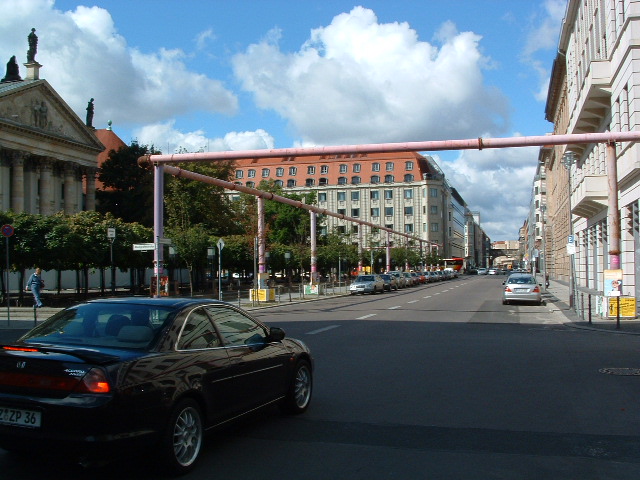


The gig itself was hot & sweaty - a proper rock n roll gig. A smaller venue holding about 700 standing. Viktor Buttner did a nice blog post on the gig (Wednesday 8th June 2010). We also sold merch (T-Shirts, CDs, LPs) at the gig for the first time in ages. I do love doing merch. Reminds me of running a market stall.

On the Wednesday morning following the gig, I drove back to London. All went well until I got to Peckham. Because of an incident the High Street was blocked. Police directed us through a 'Buses only' bit - for which I subsequently received a ticket. Welcome Home.

After Berlin, I was straight out again. This time I was working for Ms Paloma Faith who was doing the Isle of Wight festival (Saturday 12th June 2010). My first festival of 2010. A couple of old friends were there too. As I was driving rather than tour managing I spent Saturday enjoying the festival. Debbie Harry walked right by me when I was going to catering.

That's not her in the picture by the way.


So once back from the IOW, I was straight back on the case with Seasick Steve who was performing at the Meltdown festival at the Royal Festival Hall (Monday 14th June 2010). There's a set of photos from the Meltdown people on flickr. Steve started the night by spending 5 minutes in the audience (see below -picture from south bank centre London). And by the end of the night people were dancing in the aisles.


No sooner had we finished the RFH gig and I was off again. I swapped vans the day after the gig to a larger Luton style van, and then the following day broke my longest drive ever record (the one I set driving to Berlin!) by driving from home in Hertfordshire to Hirtshals in Denmark where I stayed for the night. Here's the van I did it in.
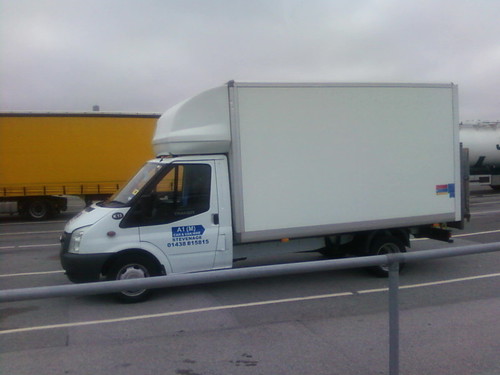

From Denmark I went over to Norway. The customs in Norway were very keen. They were training 3 sniffer dogs. I guess they saw my long hair, some guitar cases and thought drugs. They did put rubber gloves on, but didn't use them in anger. After staying over night in Norway I made my way to Amal in Sweden where the gig was to be held on Sunday 20th June 2010.

Amal is the hometown of Dan Magnusson - the Viking God of Thunder and Steve's drummer. Dan & his wife have a cafe in Amal called the Strandcafe that Dan has built himself in between gigging and recording with Steve. The view from the cafe is beautiful. The image below is stolen without permission from Roy (who does Steve's sound). I'm figuring that because its only me & 2 other people that actually read my blog I might get away with it.


The gig itself was held in an old church (from 1666 if I remember correctly) that had been converted for the evening in to a concert hall. 300 of Amal's residents had bought tickets months in advance. You can see the back of Roy's head in the photo below.
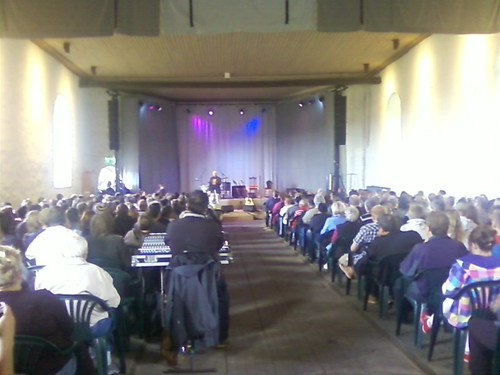

The gig was very special. We were all made to feel very welcome by the people of Amal. Although I refer to it as work on my invoice, it was actually far more like a holiday. Best not mention that to Steve. Very early the morning after the gig I set off on my greatest driving adventure to date.

On 21st July 2010 I drove from Amal in Sweden to Codicote in Hertfordshire, England. That's a long way. Over 1100 miles. It was an awesome journey. Once in a lifetime kind of thing and my longest ever drive. I could have stopped overnight if I'd liked, but once I'd got to Hamburg it felt like I was nearly home, so I drove on. The highlight was the bridge/tunnel at Malmo in Sweden which I hit at about midday. It disappears into the sea at about the halfway point.


The full list of countries that passed under wheel on 21st July is Sweden, Denmark, Germany, Netherlands, Belgium, France, England. The worst bit was the M25 roadworks. A lot of flies died on the way.


It took me a good couple of days to recover from the drive. My brother and nephew had come over from Canada in the meantime, so a busy period of meals and family gatherings ensued. At the back of my mind though was this nagging feeling that we had a little gig to do in a field near Bristol. So it was difficult to relax. In fact, that little gig had been occupying my mind for a long while. Pre-production had been relatively straight forward (which was worrying !).

My wife and kiddults left for Glastonbury on the Thursday and successfully set up camp that night. I enjoyed a night in my own bed then on the Friday I went to met the Bus in London. The trip to Glastonbury festival took ages mainly thanks to the roadworks on the M25. By early evening we'd parked up and I managed to meet up with the family. Later on I returned to the Bus to where we watched some old guy bothering Kylie on Wossy's show.


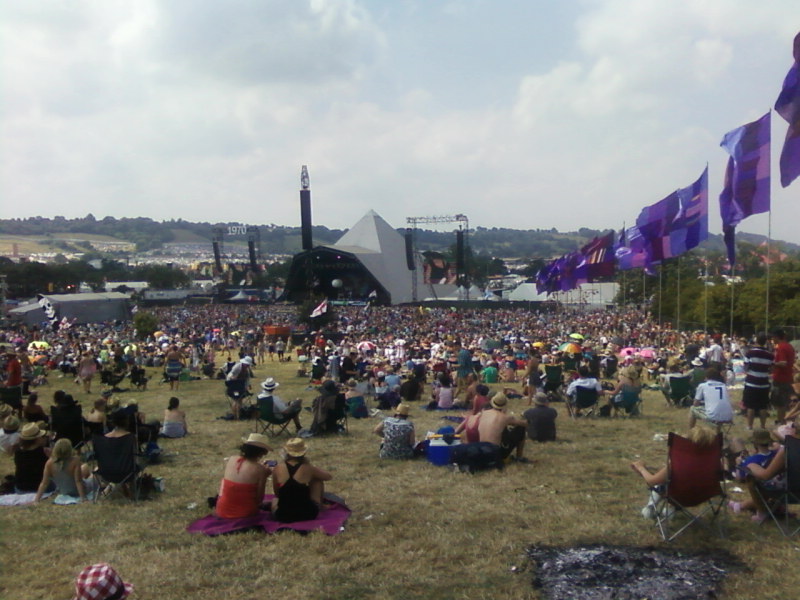
On Saturday 26th July 2010 (coincidentally my daughter's 17th birthday) I tour managed Seasick Steve while he played the Pyramid Stage at Glastonbury Festival 40th anniversary year. This is what it looked like for me. I'll happily accept it as the highlight of my tour management career.


After the show we packed away all the gear. And I began to relax. 

I saw Scissor Sisters and Muse on the Saturday night. I left the family to sleep in their tent while I returned to the relative luxury of the tour bus. Up early on the Sunday, I got off the bus which left the site, and a hooked up with my family to enjoy Sunday at Glastonbury.

I took my daughter to see Paloma Faith perform on the Pyramid Stage. Paloma's performance convinced my daughter to switch her allegiance from Florence (and the Machine). This might mean she has to dye her hair a different colour now.

The performance I was most looking forward to seeing as a punter was Faithless. I'd never seen them before. They performed at dusk. We Come One was a classic Glastonbury moment. One worthy of the 40th anniversary. I watched half of Stevie Wonder, leaving the kiddults to enjoy the remainder of his set while wife & I returned to the campsite.

At Glastonbury we had Ida (Photographer) & Henry (Drum Tech) join us in the Seasick touring party. Ida took some great pics at Glasto and of all the rest of gigs this summer, too. Here's her Glastonbury pics.

One night sleeping in a tent was enough for me. Monday morning we packed up and I drove back home along the A303 (the road that runs past Stonehenge).

I had such fun driving down the A303 that I decided to do it again the next day, this time driving to Cornwall and back for work.

After another 2 days at home doing some more pre-production I made my way to Windsor to meet the bus for the next two gigs; Hop Farm in Kent and Thomond Stadium in Limerick (on the 3rd and 4th of July, respectively).

(This is where I wrote up to by the end of July. Now its the 1st of September. I'll try to fill in the gaps as best I can)

Tom was standing in for Roy for July's gigs. So if you see a young good looking guy in the pictures (other than me, of course) its not Roy discovering a new anti-ageing cream, its Tom. Also just for these two gigs it was Guy looking after the guitars, rather than Paul. Keep up now.

Hop Farm was hot and friendly. Limerick was windy and friendly. At both gigs Bob Dylan was headlining. At Hop Farm I remember enjoying Laura Marling's performance (especially the whistling song), thinking Van Morrison was a little dull, and finding Pete Doherty's performance nicely strange (he had two ballerinas dancing for him). I heard the last 5 minutes of Afro Celt Soundsystem, which was as shame as I'd have like to have seen and heard more. Here's Ida's photos of Hop Farm. At Limerick I enjoyed the on stage chaos of Alabama 3 (who I've done a small job for in the past). I managed to catch snippets of David Grey & Dylan. Here's Ida's photos of Limerick.

I was fairly exhausted by the time I got home from the Limerick gig and was looking forward to having 8 days at home. I had running around to do, and advancing for the next gigs. But a good few days in my own bed would be very welcome.

I was back out on the road on the 15th July. Steve was playing on Rob Brydon's new TV show (being broadcast this Autumn). I think the one we recorded is out on the 24th of September on BBC2 (the first one with Tom Jones & David Walliams is on the 17th). Stephen Fry was also a guest on the show, and Rob also recorded an interview with Sir Terry Wogan. There were some great posters from shows past around the building. My favourite below.


The day after the TV show we all met the Bus in a lay-by on the M3. Rock n roll can be very glamorous. We then faced our longest Bus journey of the summer down to Aix-le-Bains near the French alps. Getting into the site was quite an adventure and by the time we parked up its was near 4am. When I managed to get myself out of bed in the morning, many of those lucky enough to have slept through had taken a dip in the beautiful luke-warm lake just a few yards behind the bus. A good start to what was to be an even better day.
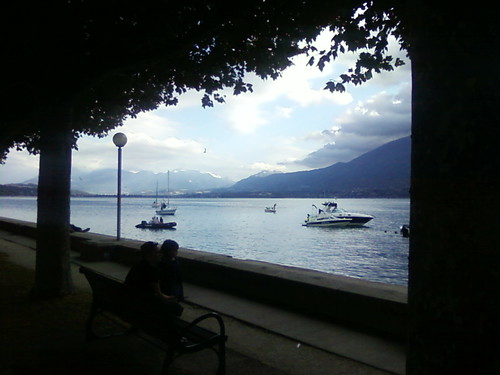


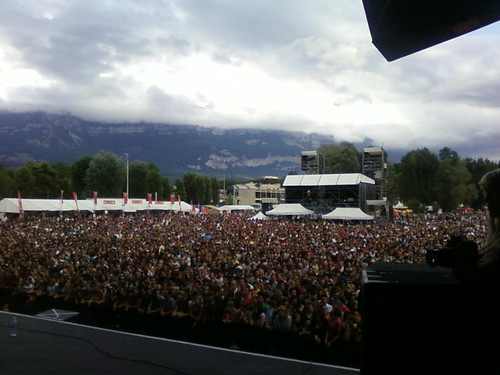
The festival was called Musilac. Its slightly unusual in that it only has two stages and they are side by side. But it seemed to work. There was only ever a 15 minute break between the acts. The mountains surrounding the site & town had cloud covered peaks but it was pretty bright and sunny in the valley with a welcome breeze coming in from the lake. The food was superb and our hosts very welcoming and friendly. We were given a boat ride on the lake in the evening, and a never ending supply of very good wine. Paul Weller, Mika, Florence and the Machine, and Rodrigo y Gabriela were all on the bill on the day Steve played. I hope they enjoyed it as much as I did. Here's Ida's pictures of Musilac, the one below I took with my phone from the stage.

Early in the morning of Sunday the 18th July the bus left Musilac and headed north to Luxembourg. We turned up at Rockhal - an indoor venue next to a disused oil refinery. Again, we were well treated by our hosts and Steve & Dan played a fantastic gig. Rockhal is an extremely impressive purpose built venue. It terms of its style and surroundings it could not have contrasted more starkly with Musilac  Ida's pictures of Rockhal are here. 

We returned to London on Monday 19th July. There was now a break in the schedule giving me a chance to catch up with the admin and prepare for the next month of gigs. On the weekend following our return I did a gig with a local band called The Whybirds at The Garage in Islington. Its fair to say that it wasn't the best attended gig I'd done all summer, but the Whybirds still rocked out and I very much enjoyed seeing them play live for the first time. Total respect to these lads - they have 2 albums to their name, loads of gigs under their belt, and their own merch lines. All done by themselves, with no record company. 

By the following Thursday 29th July the Seasick summer tour was back on again. First gig was the famous Cambridge Folk festival. Steve was playing on the Friday night. I'd never been to Cambridge Folk Festival before, so I was really looking forward to it. I have a real soft spot for anything folky. I've even been known to listen to Mike Harding's radio show on Radio2.

I have to say though, from the point of view of working at Cambridge, it wasn't the best experience. Steve & Dan had agreed to put a lot of work in - a Mojo interview (followed by a meeting/jam with a lovely group of homeless musicians), a TV and a radio interview with Mark Radcliffe, as well of course as the gig itself, and then an 90 minute signing session afterwards. This of course means a busy day for me - the TM - and the crew. The usual annoyances of poor signing on entry to the festival, informationally challenged security and incorrect passes are par for the course at festivals - all solvable and livable with. The food (and I use the term loosely) that was served in catering helped to ensure that there was no hope that the stresses and strains of the day being laughed off over a nice meal. Here's a tip to all wannabe festival organisers - don't skimp on the catering. It was an insult to all the people who work so hard to bring together a great festival - including the crew, the police & the paramedics - to serve them with food of such low quality.

I must say though, I'd definitely go to Cambridge as a punter. Some really interesting acts and a nice setting. Steve's gig was great. Steve & Dan always give everything they've got. It was also the first time they played Long Long Way with Dan on the broom. Amazing.
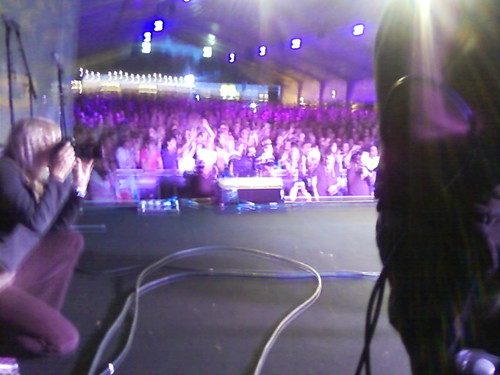

After Cambridge, I went home for a night in my own bed (and something to eat!). On the Saturday afternoon I drove up to Sterling in Scotland, then went onto Perth the next day (1st August 2010). At Perth it was back to being spoilt rotten by some lovely people. The Perth concert was part of a festival called Southern Fried which celebrated all things americana. Steve was playing in the main concert hall in Perth which had been sold out for months. Ida's photos of the gig are here.

Steve and Dan had a chance to play a longer set - after the 45-60 minute sets which most festivals demand. The audience were great - really enjoying themselves but still able to listen to and appreciate the music. Emily sold a ton of merch after the show and Steve and Dan stayed to sign for 2 hours everything thrust before them - and believe me that includes all sorts of body parts. I headed back to the hotel in Sterling with Paul & Emily after the gig. Then the following morning we drove back down to London.

Only two days at home finishing the bits and pieces from Perth, and preparing for the next gig at Newquay Boardmasters. During those two days at home my 3 year old £225 lappy broke (hard disc failed). Not what you need in the middle of the festival season - in fact it could be a complete disaster. Within a two hours of it failing I'd been to PC world, picked up a nice HP lappy for under £400, connected to the internet, and hey presto, I was back. No damage done. No emails lost. Nothing. The benefit of working in the cloud. It can be annoying if your internet connection is poor, but an absolute life saver in this situation. Expect a blog post from me evangelising about this.

For Newquay Boardmasters (6th August 2010) we welcomed back Roy, having said our goodbyes to Tom who left at Perth. It was a crazy gig. A young audience eager to party. You'd think the last thing to entertain them would be two old beardy guys. But they absolutely loved it (as did the beardy guys!). There's a 10 minute video about Seasick Steve at Boardmasters here (you have to suffer 30seconds of ads - sorry - but you do get to see a very good looking tour manager). Ida's photos are here. (again, a rather fetching picture of the tour manager)
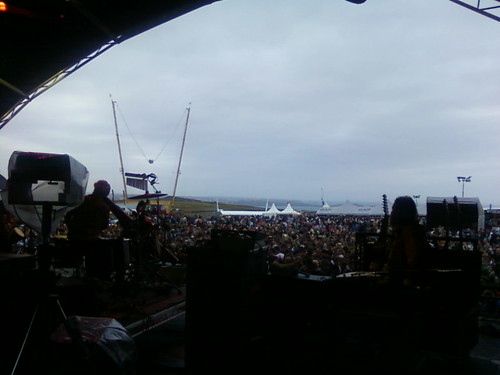

After the gig I drove with Roy and Dan to our hotel in Exeter. On the Saturday Roy returned home whilst I drove Dan to Stansted airport via a bite to eat at mine and a sneaky pint in the pub.

Another few days at home tidying up the admin and preparing for a the next gigs. Then on Friday 13th August I climbed back into the van to head to Leicester Summer Sundae via Stansted (to pick up Dan). Another festival staged with the involvement of the local council. It looked really nice when I had a brief wander around. The audience's spirits weren't dampened by the rain which accompanied a lot of Steve's set and the main stage arena was packed throughout. Ida's photos of the day are here. 

After returning home after Leicester I had to run down to London on the following day. Then three more days at home preparing etc before three really huge gigs. I was pretty tired by this point in the summer so quite glad that a very luxurious bus had been booked for Pukkelpop and the V-Festivals. 

We all met the bus in London on Wednesday 18th August. I'd made an early visit to Waitrose (and my local Butcher's, the cheese counter at the shop next door, and the wine society) to stock the bus with goodies. My wife dropped me into London after picking up a load of T-shirts on the way. The bus left London to head for Belgium just after lunch. It was Roy's last trip out with us so we gave him a card and ensured the drinks cabinet was adequately stocked.

We arrived at the Pukkelpop site late in the evening after fighting our way through a huge traffic jam on entering the site. This was no Cambridge Festival. I've heard from others working in the industry that Pukkelpop is one of the best organised, nicest to work festivals in Europe. Steve was playing on the Thursday afternoon. Blink 182, Iron Maiden, and Placebo were on after Steve.

The set up at Pukkelpop makes complete sense. There's the tour bus park (where we all stay), directly in front of that there's the artist village (where the dressing rooms, toilets, and catering are), and then in front of that the rear of the main stage. Simple. Vehicles are on hand 24 hours a day to take artists and crew to the other stages. Ida's photos of Pukkelpop are here. My one below show Blink 182's rotating drum riser (the drums are fixed and the seat has a harness so the drummer and drums can spin round through 360 degrees - we want one for Dan).
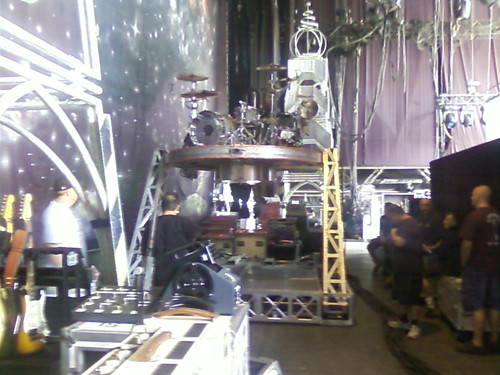


Sadly there were two deaths at Pukkelpop. The sound engineer for Black Rebel Motorcycle Club, who was also a musician and the father of one of the band, collapsed and died of a heart attack on the Thursday night. Then tragically on the Friday night the lead singer of Ou est le Swimming Pool committed suicide by jumping from the satellite mast in the tour bus park. 

We left Belgium early on Friday morning heading up to V-Festival Stafford arriving on site late on Friday evening. After a decent night's sleep I cracked on in the morning getting the merch ready and preparing with Paul, Henry, and Roy for the performance. And what a performance it was. Possibly the best short set of the summer. It never fails to amaze me to see the reaction of the kids in the audience to Steve & Dan's performance. It's a cliche to say they rocked. But they did. A signing session at the NME tent and an interview or two followed. We left site about 8pm. Ida's photos are here, mine below is of the amazing Stafford audience.


We rolled down to Chelmsford for the Sunday V-Festival and got stuck in the traffic near the site - the downside of selling day tickets, always so many people travelling to and from the site. Everyone on the bus except myself, Paul, and Christian the driver managed to sleep through the whole experience of arriving at Chelmsford. Lucky them. By 2am though we were all sorted with power for the Bus etc, and managed to head to Bedfordshire (well, Bunkfordshire actually).

I was out and about early on the Sunday sorting out some bits and pieces. Below is what the main stage looked like prior to the arrival of 90 thousand people.


Steve & Dan followed on from Stafford with another stunning performance which was lapped up by an audience eager to enjoy their day. After a brief rest backstage Steve & Dan returned to watch Madness. Halfway through the set I had to drag them over to the NME signing tent for a marathon signing session (the busiest of the day I was told) lasting an hour and twenty minutes (it was supposed to be 45 minutes). At the end of it, there were still people left disappointed because they hadn't been able to get their stuff signed. So Steve and Dan jumped over the barriers into the audience to complete the task. The security guys got a little bit panicky at this point. But of course it was all fine. I managed to sneak them backstage through a gap in the wall - where there were a load more people waiting with cameras wanting pictures etc. :o) No rest for the wicked.

Eventually, I made it back to the artist village for Steve to do a few interviews. Hanging around while Steve was doing his thing with Absolute Radio, I turned round to see Maxi Jazz from Faithless standing right beside me. So I took the opportunity to shake his hand and tell him how much I enjoyed their Glastonbury set. It was really nice to be able to do that. He told me that it was a very special gig for them too. Unfortunately I neglected to get Steve & Maxi to signing a binding contract giving me 10% of anything they earn if they do a song together. Shame. They seemed to get on well. Ida's photos of the day are here. 

We left the festival the next morning heading to Stansted and then into London to unload. I took the train home and pretty much collapsed for two days. 

Although there was no gig with Steve planned for the last weekend in August I had something far more important to plan for. My wife's birthday. As a little surprise for her I booked seats to see Chicago and a hotel in town so we could relax. I'll be honest. I don't like musicals. But I figured that at least with Chicago there would be plenty of semi-nakedness and general sexiness to keep me interested. I did end up enjoying it, but more importantly my wife loved it. Apparently, its pleasurable to watch people dancing. Who'd have thought it?

There had been 9 days between the end of the V-festivals and the next gigs at Electric Picnic in Eire and Bingley in Yorkshire. But they seemed to fly by (and obviously I didn't get this blog post finished). By the time I had recouped some energy I was back down in London meeting the bus with Paul for the journey to Ireland (3rd September 2010). As the rest of the gang were flying directly to Dublin, Paul and I had a floor each to ourselves on the bus (the same super luxury one we had for V's & Pukkelpop). I probably should have gone to bed given the day that was planned at Electric Picnic but this is rock and roll, so instead I drank wine and listened to music all the way to Holyhead. 

We arrived on site mid morning after picking up the others on the way. I managed to slip in an hour or so of sleep during the afternoon, and then we began preparations for the two gigs Steve and Dan were playing that day. The first one was on the main stage in front of ten thousand or so. Steve is hugely popular in Ireland and we always get the warmest of welcomes. Today was no exception. Things seemed to be working well for me this summer in terms of seeing bands I like - on before Steve were Afro Celt Soundsystem (whom I'd manage to miss at Hop Farm). We all really enjoyed set from backstage.

After the main stage gig was over we got the gear straight across to the Salty Dog stage for the second gig. It was a lovely gig to play for all of us. Normally with festivals its really important to keep to strict timings. At the Salty Dog gig the answer to what time are we on? was, when you're ready. And the answer to how long shall we play? was, as long as you want. Nice. :o) It was a special gig on an upturned boat in the middle of the woods. Steve and Dan ended up playing for about 80 mins. There's a couple of fun clips on youtube here and here that give you an idea of the atmosphere. Mad but great fun. Ida's photos are here.

My work was done by about 1.30am so I went back to the bus, had a quick glass of wine and went to bed. We were leaving at 5am and I had to be up by the time we got to the port at 7am to sort out a few things. Taking a ferry with Seasick Steve presents a Tour Manager with a unique opportunity to excel.  

Fortunately, with the help of various remedies, a smooth sea, and spending the entire crossing lying down in a cabin Steve managed to make it over to the UK with his stomach contents intact. We headed to Bingley with the clock very much against us eventually arriving just 75 minutes before our stage time. But the journey was soon forgotten when Steve & Dan hit the stage to play a blistering set.

It was nice to catch up with the Enemy & their crew who were playing their only festival gig of the year at Bingley. By 9.30pm the festival was over and the only thing left to do (for those of us who hadn't gone to bed) was to open a bottle of champagne and toast the end of the summer and say goodbye to Henry & Ida. 

The few days between Bingley and the next gig were filled with the usual preparations. I also found time to complete most of the second half post, but I didn't quite finish it. So these last few paragraphs are written mid way through September after the final gig at the Open House Festival in Belfast (12th September 2010) 

I took my son George with me to Belfast. He was going to sell the T-Shirts, CDs etc for Steve. We drove up to Stranraer in Scotland on the Saturday and caught the ferry over to Belfast. Turned out to be a nice day for a ferry trip. 
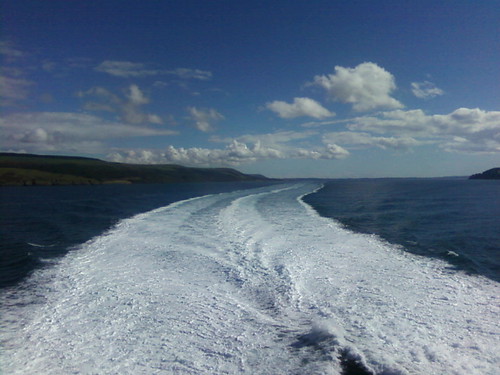


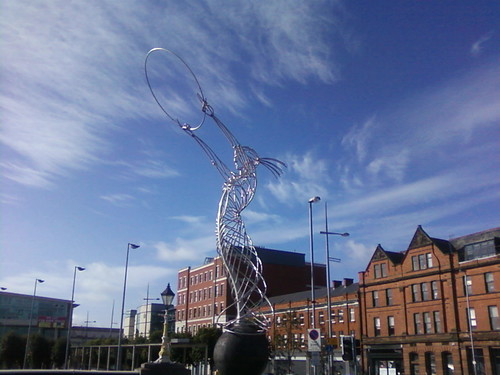
The rest of the guys flew over. We got a little spoilt by the festival and were booked into the Malmaison Hotel just a few yards from the festival site which was in the Cathedral Quarter of the city. Then on the Sunday morning (the day of the gig) I took Steve round to the John Hewitt pub where he played his first gig in the UK back in 2005 and he was now unveiling a plaque. There's a picture of the plaque (and a review of the gig) here. I really liked Belfast. Obviously for people of my age Belfast has some very negative connotations. This trip successfully dispelled the troubled image of Belfast. 

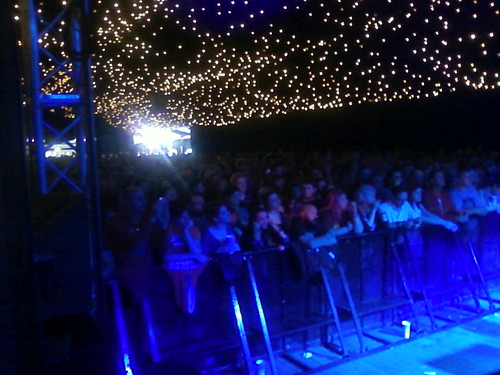
The gig itself was a fitting end to the Seasick Summer Tour 2010. The tent looked fabulous lined with hundreds of stars. Steve & Dan played for the absolute maximum time, running right up to the curfew. Something which was appreciated by the crowd even if it made the Stage Manager a little nervous (fines would have been imposed if we'd gone over). 

George and I left the hotel at a civilised time, and after a hearty breakfast on Monday morning and headed back to Stranraer on the ferry. The crossing was a bit rough. And the drive back through the lake district was done mostly in a cloud. But we made good time all the same getting home to Herfordshire by around 9.30pm.

You know how much I love driving. Oh yes. A trip to Scotland and back just whetting my appetite I had some running around to do in the few days following so managed two trips to London, a trip to Norfolk, and down to Cornwall. Then I enjoyed my first weekend without a gig to worry about. I did nothing. It was great.

So there you have it. A travelogue of my summer 2010.  To put a few faces to the names for you. The photo below was taken after the V-Festivals. 


Left to right we have Roy, Dan, Steve, Paul, Henry, Ida, & Yours Truly. Missing from the picture but there in spirit are Elisabeth, Didrik, Emily, Tom, Guy and Lee. And all our Bus Drivers - Mike, Carl, Kev, Malcolm, and Christian (who took this picture). Thank you to all the crew, security, production, artist liaison, media people and festival goers whom we met along the way. Its been a blast.

You can keep up with all things Seasick Steve through his facebook page, his twitter account, or via his website.

Wednesday, May 12, 2010

A Miscellaneous Post

After six months or so of silence I finally feel overwhelmingly compelled to post. It's on nothing in particular. Just updating you really. And there's no valid reason why I couldn't have done this 5 months and 3 weeks ago. Still, better late than never.

Orange Post
I did make a noise a few weeks back about doing a post on a bad experience we (myself, wife & son) had in an orange shop when my son bought his iPhone with his first ever wage packet. I didn't make the post in the end. To be fair to Orange, they did sort it out. The villain of the piece was a nasty little chap who was the manager of the orange shop. The post would have been about this odious little toe-rag, rather than anything particularly useful. So I really didn't want to use my blog as a means to vent my spleen.

Poker
Yeah. I've been playing a lot of poker. I enjoy it. Its a fascinating game. And there are some huge - and I mean HUGE - prizes for those who manage to win. I reckon I'm about a year into my obsession with the game, and I can see it lasting a while longer. Sorry if tweets like this  - 'last hand. i had K4h in SB. only BB to play. i call. he checks. flop comes xAx. i represent the A with an all in. he calls. with A2 (7th May)' - make no sense at all. Basically though they all say the same thing - 'I lost and its not fair'.

Money
No posts from me on this for a while either. My mind is working on it though, for sure. I've made a couple of attempts to write a piece that's been on my mind a while, but it wasn't working on paper. I didn't want to force it. Poker is giving me much to think about - in respect of money. I don't just mean in terms of my bank balance, but also my understanding of money & the dynamics of economic relations. And its only 5 months or so until the next burning. I'm looking forward to that. If anything, my thoughts on 'what money is' are becoming more radical (or crazy depending on you p.o.v.).

Work 
I'm just about to start a very busy period work-wise. For June, July, August & at least half of September . I'm really looking forward to the gigs - especially Glasto (main stage, Saturday afternoon).

Reading
I seem to have forgotten that I really enjoy reading. So far this year I've read 'The Pound - A Biography' by David Sinclair. I enjoyed it but found (as with Lords of Finance) economic theory was taken as natural law - which obviously its not. I've also read 'Holden on Hold 'em' by Anthony Holden. A nicely written poker book, which I enjoyed and found useful. I've dipped in and out of  'Economic Philosophy' by Joan Robinson. This is quite a famous economic text - one of those books you 'should' read. I like most things that at least try to get to grips with the 'essence' of money and the economy. This is one of those great books on (what most people consider) difficult subjects but written for the general reader - like Bertrand Russell's Western Philosophy or Hayek's Constitution of Liberty. Note to self - read more, you love it.

Internet
Its obvious that I've been particularly neglectful of my internet presence in recent months. I'm in the process of convincing myself to invest in an iPhone - I need a new tomtom and a new phone, so I'm thinking I might as well bite the bullet and get myself an iPhone with the tomtom app and gps base (I was waiting for an Android phone but after comparing my son's iPhone with HTC's offer, even I have to admit that iPhone is still a long way ahead). Anyway, I expect that having an iPhone is going to have a major impact on my relationship with the internet. It'll make everything more instantaneous for a start. Secretly, I'm quite excited about this.

So. That's about it for my first miscellaneous post. What passes for normal service will be resumed at some point.

Friday, December 18, 2009

Rage against the xfactor

In a couple of days from now we'll find out if Rage Against the Machine's iconic track 'Killing in the Name' is going to be 2009's Xmas number one. Before the internet campaign began, xfactor's domination of the xmas number one spot looked set to continue. Although its close, RATM is the favourite to win.

I paid to download the track and I really hope it does reach number one.

And I think this campaign marks a significant moment in history of the music industry.

Here's why:

1. Its Old Media Vs New Media.
On the one side we have a saturday night light entertainment show, the sales and marketing focus of one of the largest record companies, and the backing of a man named-dropped by the President of the United States of America. On the other, 850 000 people, a facebook page, and a great song.

2. Its Good Music Vs Bad Music.
Some music is a genuine expression and exploration of what it is to be alive. Some music exists only to exploit us for commercial gain.

3. Its Scheduling Vs Sales.
The persausive power of a television institution, the attention of 20 million viewers, the action of millions of phone voters, set aside by the economic power of a just a few hundred thousand individuals focused on acheiving one goal.

....and most important of all.

4. Its a signpost to a new future.

A future where the fusion of money and art nourishes the human spirit as never before.

Getting there might be tricky though. Cynicism and apathy will deplete our energy.

But for a time at least we'll be following in the tracks of the pioneers. Pioneers like Sellaband and SlicethePie who have explored fan funding; like Last.fm and Blip.fm who try to marry music with social network; like 8tracks and Muxtape (RIP) who rely on our love of music to exist; like Napster and Pirate Bay who thought that above all music should be shared freely.

The destination is a place where you and I can listen to whatever music we want, whenever we want. For nothing. Surely, we all want that?

And future stars will flourish and prosper.

Because at the heart of the industry built around recorded music there is a not-so-well-kept secret. Promotion is the key that unlocks financial success. The songs that are the most financially successful have always been those that most people have heard for free, first. Only then do they buy a record, t-shirt, or concert ticket.

For a more detailed picture please take a look at my 'A Brief History of the Pre-Internet Music Business'.

The music industry of the C20th needs have faith in music to make the transformation into a music business fit for the C21st century.

If it doesn't we will kill it. In the name of music.


I salute Jon & Tracy Morter who founded http://bit.ly/inthename

RATM - Killing in the name
Joe McElderry - The Climb
A Rage Against the Machine Christmas
Rage Against The Machine / Zane Lowe vs. Simon Cowell / XFactor

Friday, December 11, 2009

How to create a one click follow list on Twitter

Follow fridays are a great idea. Its good to revitalise your following. However, there is a downside. Friday's twitter stream gets really clogged with #ff, and following each recommendation can be time consuming.

If I do follow a recommendation its usually one that's made personal; e.g. follow @thisperson because they're funny and post nude pics of themselves occassionally. That sort of thing. These personalisations are great, but they do take time to write. Plus, everybody I follow is fabulous in their own unique way. It never seems completely fair to recommend just a few people out of my whole twitter stream.

So here's what I'm trying now. A one click follow list.

And here's how I did it.

1. Trim your following. Cut out those who've fallen by the wayside.
I use http://friendorfollow.com to do this.

2. Create a list of everyone you follow on twitter.
Just click 'new list' which is on the right of your twitter stream. I created my list manually - it took 20 minutes or so for 200 people. I'm sure there'll be an automated way of doing this but I've not yet found it.

3. Create a one click follow list.
Go to http://tweepml.org/. In the box that says follow a twitter list just enter twitter username/list name or the url of the list (e.g. jonone100/everyoneifollow-11-12-09 or http://twitter.com/#/list/jonone100/everyoneifollow-11-12-09)

4. Create a link so people can follow with one click.
The link is just the list page on Tweepml. So the address for my list is http://tweepml.org/@jonone100/everyoneifollow-11-12-09. You can shorten this to make it easer to tweet. I use tinyurl, but there are loads of url shortners. This is the shortened url: http://tinyurl.com/y8lps3c

5. Add the shortened address to the list description (unfortunately, it won't be clickable).

6. Let people know.

So there you have it. I love the randomness of following people you don't know. My twitter stream has one bishop, several writers, musicians, some very naughty people, and lots of wonderful microbloggers. And Stephen Fry, of course.

I hope you get as much out of this way of doing things as I have. If you find quicker and easier ways to do this please let me know!

Monday, November 23, 2009

Book Review - 'Lords of Finance' by Liaquat Ahamed

I've just finished reading 'Lords of Finance' by Liaquat Ahamed. I started it when i was on tour on September and only just finished it. So taking over 2 months, it'd be fair to say it was a leisure read for me. I think my slow pace made it all the more enjoyable.


The book is about the Great Depression seen through the eyes of the four most important central bankers of the time. Montagu Norman from the bank of England, Benjamin Strong of the New York Federal Reserve, Hjalmar Schacht of the Reichsbank and Emile Moreau of the Banque de France. The Great Depression was a time between the first and second world wars when many countries experienced huge economic difficulties. Central to the story are 'reparations' - payments which Germany was forced to make after the first world war - and the Gold Standard. Money was linked to the amount of Gold available. The period saw changes in the relationship between money and gold.

I've studied the Great Depression as an undergraduate at the London School of Economics. A lot of the academic literature is pretty dry. Liaquat does a brilliant job of bringing the story to life. By personalising the events, by seeing them through the character's eyes, you gain a new insight into the story. And a truly amazing story it is. At the same time it is both mundane and fantastic. For a moment, think about all those millions of lives effected by the economic catastrophe. Imagine the hunger, deprivation, and desperation. Now, read this.

'Bullion was so heavy - a seventeen inch cube weighs about a ton - that instead of shipping crates of it across hundreds of miles from one country to another and paying high insurance costs, central banks had taken to "earmarking" the metal, that is, keeping it in the same fault but simply re- registering its ownership. Thus the decline in Britain's gold reserves and their accumulation in France and the United States was accomplished by a group of men descending in to the Bank of England, loading some bars onto a low wooden truck with small rubber tires, trundling them thirty feet across the room to the other wall, and offloading them, though not before attaching some white name tags indicating that the gold now belonged to the Banque de France or the Federal Reserve Bank. That the world was now being subject to a progressively tightening squeeze on credit just because there happened to be too much gold on one side of the vault and not enough on the other provoked Lord d'Abernon, Britain's ambassador to Germany after the war and now elder statesman-economist, to exclaim, "This depression is the stupidest and most gratuitous in history".
pp 379

Liaquat provides a wonderful anecdote in the footnotes telling of when the Schacht - the German Central banker - visited the New York Fed. He wanted to see Germany's gold reserves (held by the Fed). But the Fed officials couldn't actually find Germany's pallet of Gold. You couldn't make it up !

Liaquat provides us with a rich history. He paints the characters beautifully. You gain a real sense of the dynamics of the relationship between the four key individuals. Relationships upon which depended our prosperity. And whilst there is inevitably some reference to the well-heeled life of the bankers, you also appreciate them as people. They display stunning arrogance and stupidity, but also a sense of selflessness and duty. Liaquat finishes the book by referencing Keynes (who also, alongside Churchill, is obviously featured heavily). And in doing so perhaps gives us a small insight into why he took on the huge task of writing this book (taking a break form his career as a successful investment banker).

[Keynes] believed that if only we could eliminate 'muddled' thinking... in economic matters, then society could allow the management of its material welfare to take a back seat to what he thought were the central questions of existence, to the "problems of life and of human relations, of creation, behaviour and religion."
pp 504
Keynes described economists as "trustees, not of civilisation, but of the possibility of civilisation".

And despite all my praise for Liaquat's book - it will sit on my bookshelf alongside AJP Taylor's English History 1914-1945, and Glyn Davies A History of Money - it is here I must offer some criticism. And doing so, agree with Keynes. Liaquat at points seems to write from the perspective that we have solved economic problems. That we know what money is now, whereas back then we didn't. Whilst this might be reassuring to the reader, it isn't true. He displays much greater faith in the 'science' of economics than it deserves. Indeed, Keynes would have described the four central bankers as exponents of the art of economics.

I wonder if Liaquat has read Black Swan by Nassim Nicholas Talib - a fellow investment professional ? Economics, as a means to an end, is hocus pocus. Montagu Norman (Governor of the Bank of England) said in 1948 two years before his death:

"As I look back, it now seems that, with all the thought and work and good intentions, which we provided, we achieved absolutely nothing... nothing that I did, and very little that old Ben [Benjamin Strong] did internationally produced any good effect - or indeed any effect at all except that we collected money from a lot of poor devils and gave it over to the four winds."
pp 489
It is to Liaquat's credit that he includes the above quote in his book.

For a moment whilst reading the book I did wonder about my own choices in life. I did wonder whether I should have done the sensible thing tried to pursue a career in economics rather than writing weird stuff about the nature of money, and burning some of the stuff once a year. But reading quotes like that one from Norman, reassures me that although I might not be on the right path, for me, economics (with its current dogmas) would be the wrong one.

Tuesday, November 3, 2009

Money Burning 23-10-09 £50

I did my third money burning ritual on Friday 23rd October. This time I burnt £50, last time it was £20, before that £10.

I recorded the serial number of the £50 - M10 362939. I probably should have done this for the £20 and £10. Perhaps it was added significance of burning the highest value note (in common usage in the UK) that encouraged me to record the note's number. Being a child of the 70's I associate the £50 note with oil sheiks and second-hand car salesmen. I don't think I actually saw one until I was in my twenties.

It certainly felt like a lot of money to burn.

I could have spent £50 in so many different ways. My family didn't fail to remind me of that. Their protestations didn't fall on deaf ears, but I  felt committed to the burning. I don't think my ego would have allowed me to 'fail' for the sake £50. However, the size of the burning definitely meant my resolve was put under greater strain than in previous years. I guess whether my resolve holds into the £100, £200 and £500 years will depend, at least in part, on my financial situation.

I should point out to those who don't know me, I'm not rich. Yet, anyway ;o)

To put things in perspective, in the last three years, my money burning activities have released me from the custodianship of £80 (not cost, remember?). I don't feel guilty, or silly. The burnings have given me pleasure (I guess some might call the pleasure perverse, although I wouldn't) and inspiration. For me its also been a profound way to explore my relationship with money. It does feel like a sacred ritual.

I wouldn't like anyone to think that burning the money was an act of arrogance or some vulgar display of wealth. I don't light a cigar with the note ! In fact, even though the act is the same, they couldn't be more different. That sounds bizarre I know. The best analogy I can draw for you is with sex. It can be a wonderful transformative event, or the greatest violation; physically its the same act.

I was disappointed that the youtube recording of the burning failed. The video didn't process properly, and because I recorded it live via a webcam, its gone forever. I was however very pleased that half a dozen or so, bore witness to the burning via a live webcast. To the best of my knowledge, they were all fellow microbloggers. All were really positive about what I was doing and offered encouragement. I'm very grateful to them for sharing the moment with me.

My son recorded a little video of me changing up the 2 x £20, and 1 x £10 in the village bank. I wasn't trying to offer proof that the £50 was genuine. It is. But attempting to prove that to anyone who doubted it would be extremely difficult. What I wanted to do was give a sense of the events around the ritual (which really form part of the ritual itself). The 23rd of October is starting to feel like a special day to me.


Since the burning, my friend and colleague Mark Sampson (@IronManRecords) has burnt £10.


I'm really really happy that someone else has taken to burning money. If you've read this far, then you should too. Money is so much part of all our lives that you should 'invest' just a little of it to find out how you really feel about it.

Tuesday, September 1, 2009

How I find music

I'm not a great hoarder of cds. We do have a trunk full of them at home, but they are not ordered or categorised. And I rarely play any of them. At some point, I intend to digitise my favourite tracks in order to create some mixes. I think I'll enjoy putting them together and it'd be nice to share them, too. But for the time being, I enjoying listening to music that I don't own* (like I do the cds), and I don't have to endure djs and advertisements to hear. These days, I listen to all my music on the internet. As a result I've listened to more new music in the past three years than ever before. This hasn't been a task I've set myself. Its a natural result of the changes in the way I choose my music.

When I say new, I mean new to me, as well as new to all of us.

One of the things that works against new music discovery is the traditional way that music carriers (vinyl, cd etc) have been presented and sold to the public. Classifying music by genre is how record shops and record companies have sorted their offer for us. Its a route to music discovery based around 'likeness'. And its an idea that has been carried into the digital age.

I have a few problems with this approach.

The first thing is that I always end up listening to music I've heard before. Familiarity in music is a powerful thing. Presented with a choice between a piece of new music, and a familiar favourite, I'll most often go for the later. The longer and broader one's musical experience, the worse this problem becomes.

Secondly, I hate it when discovering music becomes a task - a job of work. I don't want to have a disciplined approach to music. I don't want to examine a genre, or appreciate an artist's body of work. I'm lazy and I have a short attention span. I don't need no education. I want something I love in the here and now. Life is too short.

And thirdly, I like difference as well as likeness.

Likeness then, isn't necessarily the best criteria to find new music.

Charts help overcome these problems, encouraging the discovery of new music by providing us with information about a song's popularity. Unfortunately charts also provide a target for manipulation. This gives the competitive advantage to those who are best at manipulation, rather than those who are best at releasing music.

But then the places where art and money meet can be a difficult landscape.

For me, Last FM probably best typifies the transference of the traditional music selection and sales models onto the internet. Indeed, their tag line spells it out. "Last.fm recommends music, videos and concerts based on what you listen to." I think Last FM is a great site. But it is very C20th. And I don't use it.

Other behemoth sites work along similar lines, albeit with more emphasis on the notion that you should pay to have access to a piece of music (seems a bizarre idea to me). And I have a more practical problem with spotify, itunes and the other download-a-piece-of-software sites (including Last FM's scrobbler)'. I simply don't trust them. Silly, maybe. But the music industry is an injured beast at the moment just looking for people to lash out at. I'll let Google penetrate my portals, but not anyone who's sleeping with the music industry. You never know what you might catch.

Plus. I can stream pretty much any piece of music from somewhere. I use Grooveshark a lot, but there are other good ones.

There are two sites where I do perhaps 95% of my music listening. The sixtyone and 8tracks.

The sixtyone is based around gaming. Charts of songs are created according to their popularity with the site's audience. Music on the sixtyone can come from anywhere. A major recording studio, or an artist's bedroom. The beauty of the site is you can just click play and listen to new music. Sometimes I choose a genre, sometimes not. I love the idea of melding together market/gaming dynamics to filter music through a community - this has to be the most innovative solution to music discovery on the internet. However, what the sixtyone gains in technological innovation (both in a narrow and broad sense) it lacks in style. To me it sometimes has a sense of an embattled community. I wish the founders had more confidence in their gaming approach and worried less about the music. Us listeners will do that.

8tracks is a very different beast. It starts from a very simple, yet powerful idea. People put together mixes of music they like, and share them. Its a stylish site. Very Web 2.0. One simple idea, done well. Put simply, its cool. It has similarities to the traditional approach. But rather than appearing in the form of recommendations based on likeness, your musical discovery is assisted by art - by a fully formed mix put together by human beings. If you really enjoy someone's mix, you'll want to hear more from them - that's a better use of 'likeness' in music discovery. The path from music discovery to social network is entirely organic.

I had a short dalliance with Blip FM, which I liked. A bit like twitter with music. But I didn't really discover new music on it. Where as with the sixtyone and 8tracks new music discovery seems unavoidable.

And a last word goes to the old fashioned idea of combining a great knowledge of music with great writing. Headfullofsnow is the creation of Nick James aka @Jeffman1. Its an on-line music magazine with a focus on Psych, Rock, Prog. It's my sort of thing, and I like it. Thanks to HFoS, for the first time I listened to the whole of Sticky Fingers by the Stones. I've repeated that several times, now. I hope there's someone like Nick doing the same thing for punk, jazz, baroque and every other style, genre and variation thereof.


http://www.thesixtyone.com
http://www.8tracks.com
http://www.headfullofsnow.com
http://www.lastfm.com

I'm sure you can find the rest. Happy listening.

*own - yes, i know. we just rent the right to hear it.

Wednesday, May 6, 2009

"Hope" - musicslideshow

To get the best effect please view this full screen and listen through headphones (or decent speakers).
You need to hit play on both the slideshow AND music track - one after the other, fast as you can !! - you choose which you do first!
(The speed setting on the slideshow should automatically be set at medium). The music and slideshow last for just under 3 minutes. You'll kind of spoil it for yourself if you look through the images first, so please let them just come to you with the music.


@kate_day mentioned audio slideshows on twitter a couple of weeks back. I used to enjoy watching and making them. I've put this one together over the past couple of weeks. Copyright issues tend to put a damper on them being used professionally. But I think I've got round those issues with the way I've prepared this musicslideshow (let's call it an MSS).

If you want to find out who took a particular picture, and then maybe check out the others from that set, just play the slideshow in full screen and click the info link when your chosen picture is displayed. I'm going to contact everyone who has a image in the slideshow and of course, William Fitzsimmons who wrote and performed the song 'Beautiful Morning'. And by the way, William is in the UK next week ! At Bush Hall (shepherds bush) next wednesday 13th May, Brighton on Thursday 14th May, and Bardons Boudoir on the 15th May.


I don't really want to give an explanation the MSS itself. Its theme is Hope. Other than that you can make your own mind up about it.

Technical Stuff
The music is just embedded from a site called http://www.thesixtyone.com. So no copyright issues here to worry about.

The slideshow is embedded from flickr. I favourite the images I choose for this and placed a start and end image in these don't seem to be working; so when you see pictures of clouds the show is over ! If you let the slideshow run after the music finishes you see the rest of my favourites. I unfavourited the rest of my favourite images to help this MSS make sense (I've taken a note of them though so will be putting them up on tumblr soon). I did decide on an order in which the images should appear, so I had to favourite them in this order.

Flickr does give you some control over the which images from your favourites you place in a slideshow. I did experiment with this. You use the search feature to select in, or select out, images tagged with a particular label. However, I found that when I set the slideshow to play I encountered problems. It didn't seem to play at all if I selected out particular tags, and even if I unfavourited an image, it still appeared in the slideshow.

So what I ended up with is the simplest method of showing a slideshow of my 'favourited' images. Using a flickr created slideshow does have the benefit of getting around copyright issues. The image producers will have already have given their permission to flickr for the images to be used in this way. (Of course, if anyone does object to me directly I will remove their image.)


I hope you enjoyed it. And I hope it was a little light relief from my money posts - which I think might be quite hard going sometimes ! Please do let me know if you like it - I'll do more then ! And please RT on twitter, too. Thank you.

Oh. And please have a go yourself. Its a really enjoyable process.

PS. I'm happy to expand upon the technical process stuff if people want me to, so you don't have to go through the tedious experimentation I did.

Friday, April 24, 2009

Money - 7. The Budget 2009

A Caveat to the unfamiliar: I think money is a force. For me, price is to money, as weight is to gravity.

The Budget delivered by Alistair Darling, our chancellor of the exchequer, on Wednesday 22rd April 2009 was historic; apparently.

It must be good to be an economic or financial journalist right now. A normal budget would keep journalists busy enough, but an historic one ! That has to be the highlight of a financial journalist's career. Personally, I've always found Budget Day extremely dull. Even the wittiest, most engaging writer would find it difficult to hold my interest. Like the majority of people, I want two pieces of information. One; how much is booze going up? Two; how much are fags going up? And, as I no longer smoke tobacco, I'm not really interested in number two, any more.

Are people genuinely interested in what the Budget says? I reckon that they're faking it. They feel that they need to be seen to care. They'll watch the news, read a paper, and maybe they'll get a letter from their accountants outlining the key measures and their likely impact - enough to allow them to appear to their colleagues that they know their stuff, but that's about it. In truth, they're likely to be more concerned about their current cash crisis, or the one looming, or the one they've just got over (although 'getting over' a cash crisis is becoming rarer). Two percent on this, or three percent on that after such and such a date, probably means no more to them than it does to me.

The Budget isn't really about money at all. Its about politics. Its one battle in an ongoing war. Both sides want us to believe that it is they, not their foe, who can best control the State's money-power.

The rules of engagement for the Budget day battle are as follows. The incumbent power must declare their tactics for the next year's custodianship of money-power; their strategy for dealing with money-power being set in their election manifesto. Once declared, the opposition can then criticise both the tactics and the strategy of the incumbent. The opposition often focus on any inconsistencies between them. Like when the government has achieved political power on the promise of not raising taxes, and then it does. However, such discussions can quickly numb the mind. So, both sides eventually revert to making direct attacks on the capacities and capabilities of the people involved. Like they really matter !

Attacking people for their failings is reassuring. It helps to convince us that it was someone's fault. It's nice to believe that people count. But do you really believe that if a different man or woman had been Prime Minister, or Chancellor, things would be that different? I don't. Most of us have enough trouble being custodian to our own money-power. Can you imagine quite how impossible it would be to look after the money-power of the British State?

The British State's claim on the money-force is determined by an infinite number of possibilities, the vast majority (if not all) of which are not under anyone's direct control. There is little real agreement about what's happened to British money-power in the past because one's view of the past is so dependant upon one's current political and ideological sensibilities. Predicting the future of British money-power is a highly suspect activity. You might as well read tea leaves. Our relationship to the money-force is in trouble because we fail to recognise our own limitations. The Budget serves to reinforce this failure year after year.

A persuasive argument for the value of the political ritual of the Budget is that it replaces the conflicts of earlier times; as to a certain extent all political rituals do. Instead of rich barons squaring up to the King over his demands, or vice versa, be-suited politicians glare and shout at each other across the floor of the house of commons. People keep their heads. But it is our choice of peace over war, of non-violence over bloodshed, of national politics over tribal conflict, that has created our history. The Budget is just an argument about our circumstances today. Its hard to imagine a Budget - even an historic one - changing the course of history. Ideas do that, budgets don't.

That's what I reckon. Here's what a very clever Welshman says about the money battle: 
We shall see as our history of money unfolds that there is an unceasing conflict between the interests of debtors, who seek to enlarge the quantity of money and who seek busily to find acceptable substitutes, and the interests of creditors, who seek to maintain or increase the value of money by limiting its supply, by refusing substitutes or accepting them with great reluctance, and generally trying in all sorts of ways to safeguard the quality of money.
Glyn Davies - A History of Money (p. 29)


Friday, April 17, 2009

Money - 6. Counterfeiting

Recently, an 83 year old man escaped a prison sentence for helping to forge £8 million. In earlier times, this crime would have cost him his life.

If you decide today that you've had enough, and from tomorrow you're going to make money without regard to the law, how would you do it? How would you get rich quick? With the gateway to criminality open, creating counterfeit cash would surely be your best bet. The advances in and availability of, reproduction technologies have made it easier than it used to be. And now, even if you do get caught, which seems unlikely if you act with due diligence and aren't too greedy, your punishment wouldn't be too severe. It would seem rather harsh for the courts to dish out long sentences to punish culprits for the harm they're doing to the economy. Even the largest most determined counterfeiter would find it hard to match what the banks have done.

When I was growing up, if you decided that you'd had enough, you'd say 'I'm going to rob a bank'. This was an expression of feelings and a statement of intent (albeit one very rarely acted upon) that was socially acceptable. People would react rather differently if you'd said 'I'm going to rob a granny'. In essence the crime is the same, you're taking something that clearly doesn't belong to you. But grannies fit our notion of victim hood, banks do not.

These days, I reckon we should say 'I'm going to print some cash', when we want to express those feelings. Why have any victims at all?

Counterfeit cash has no victims. At least, there are no victims while we maintain the believe that the cash is real. When someone creates a fake £10 note a [false] debt is raised against the Bank of England. But, as long as the bank remains sound, and as long as the note itself is believed to be real, the £10 note functions as well as any other. Assuming the Bank of England can detect the counterfeit it can refuse to honour the £10 debt because it did not create it. So, essentially the counterfeiter has loaned national economy some temporary liquidity at his own risk and at no direct cost to the central bank. In payment of his [illegal] liquidity loan he gets whatever his counterfeit cash can buy him.

This might seem an odd way to look at things. But in the past it might have made more sense. In the days before paper money, Kings and Queens found it expensive to provide coinage for their subjects to use in economic exchange. There was huge demand for coins. To provide them, a King would strike a deal with his minters to share the profit made by 'cheating' the coin out of it's full value of precious metal, by making it lighter than previous issues, or using alloys. Debased coins and counterfeit cash are essentially the same thing. Both provide real liquidity. Its estimated that '1 in 20 £1 coins [in circulation in 2009] are fake'. But a counterfeit £1 is still a real coin; a counterfeit Louis Vuitton handbag, is a fake Louis Vuitton, but its still a real handbag.

Counterfeiters do not create fake money; what they do is make a false claim on the custodianship of money-power. All of us are at least guilty of overstating our money-power at some point in our lives. Banks especially. It comes with the capitalist territory.

The primary claim to the custodianship of money-power comes from the state. The claim the British state makes bears the £ symbol, of course. We know and respect this symbol as a mark of British custodianship of money-power. All claims made with this symbol are, ultimately, subordinate to the British state. The British state's claim is itself subordinate to the world's most powerful symbol. Currently this is $ symbol. All around the world people in their day-to-day lives believe that the paper, duly authorised to bear this symbol, is money (they're wrong of course - its just cash). The custodianship of money-power cannot be maintained without our belief in these symbols. Should that belief waver, the custodians of money-power fight to keep the faith. To this point in history, military strength and money-power have gone hand-in-hand.

This is the power structure that counterfeiters are subverting.

However, the paradox of counterfeiting is that so long as it remains hidden, it actually helps the economy. To damage the reputation of the symbol it mimics, counterfeit cash needs to be recognised as counterfeit. This sets up an interesting dynamic for the State. Its in the State's best interest to keep quiet about the levels of counterfeit currency. And it might actually be better for the economy to have an unnoticed level of counterfeit currency circulating. Liquidity is increased, but central bank debt levels are not.

I'm not suggesting that for you, or me, counterfeiting cash would be a good thing to do. It's fundamentally dishonest; it makes liers of us. But we should try understand it.

Hayek - [you don't know who Hayek was? if Keynes were Jesus, then Hayek is God, and Marx is the Devil, or vice versa, depending on your p.o.v.] - argued that citizens should be free to use and refuse any currencies they wish. He thought that if the state monopoly on money creation was ended we'd be free from cycles of inflation and deflation, so that the unemployment and depression often blamed on capitalism would be cured. He published a paper on it in that special year 1976 (1 + 9 + 7 + 6 = 23). He was quite old by then, so most people just thought he'd gone a bit mad. I think he was on the right track. In fact, I'd go quite a lot further than that.

No quotation for you this time. Instead a link to Lawrence Malkin's site about operation Bernhard. This was a Nazi plan to destroy the British economy by issuing, Malkin estimates, $650 million worth of counterfeit British notes (that's about six or seven billion in today's money). Obviously, it didn't work out too well for the Nazis.